
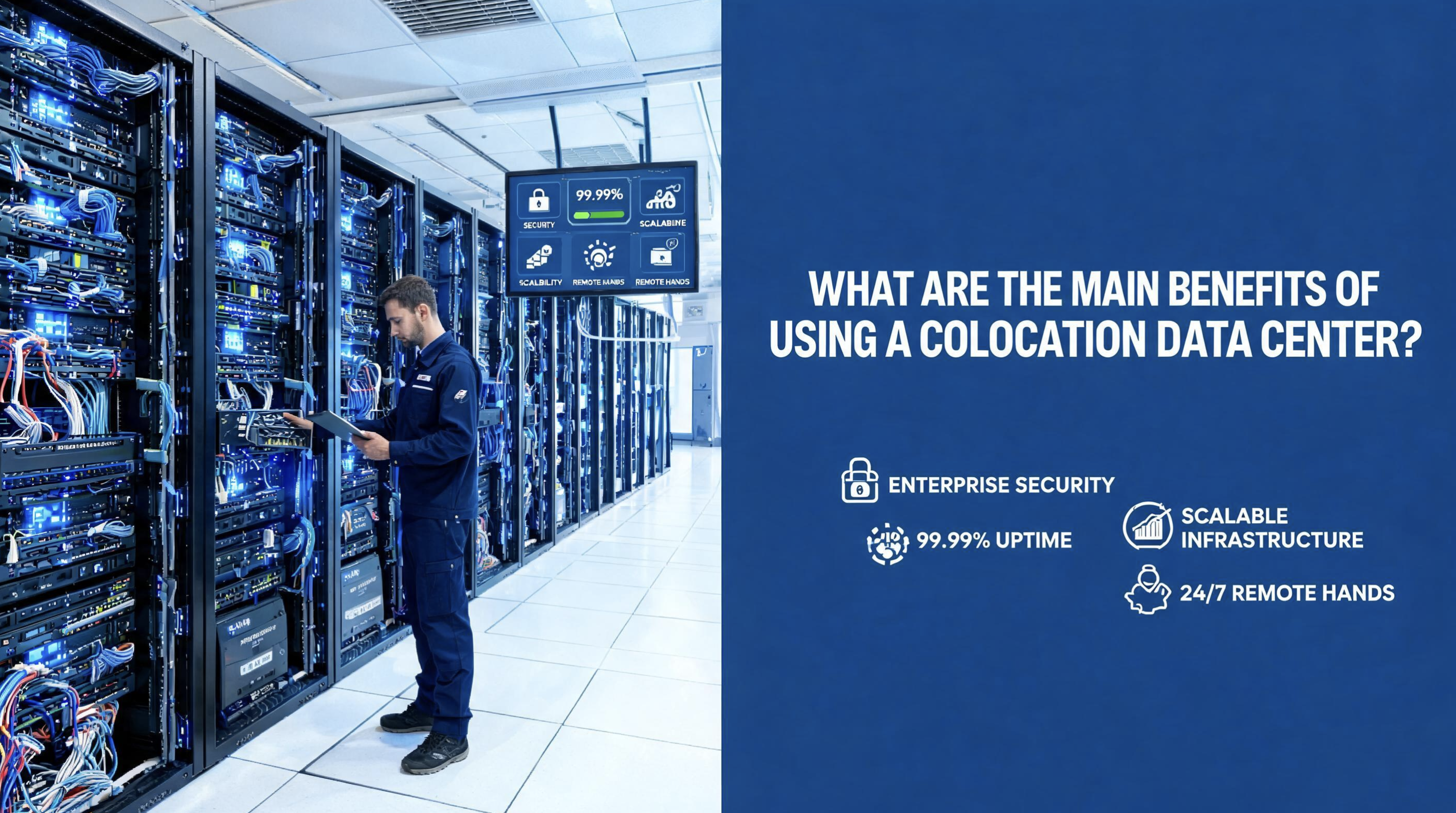
Colocation data center benefits are becoming a major reason businesses move away from building and maintaining their own server rooms. As infrastructure demands grow, many teams want more uptime, stronger security, and better scalability without the cost and complexity of running a private facility.
Today’s IT leaders are under pressure to support more applications, more traffic, and more compliance requirements while keeping systems reliable. Colocation data center benefits gives organizations a way to keep ownership of their hardware while outsourcing the facility, power, cooling, and physical security to a specialized provider.
What is a Colocation Data Center?
A colocation data center is a third-party facility where businesses place their own servers, storage, and networking equipment in rented rack space or cabinet colocation. The customer owns the hardware, while the colocation provider owns and operates the building, power systems, cooling, network infrastructure, and security controls.
In practice, server colocation works like this: your team purchases and configures the hardware, ships it to the provider, and the provider installs it in a secure environment with redundant power, cooling, and connectivity. Your organization keeps control of the software stack and hardware choices, while the facility handles the building-level infrastructure.
This model is especially useful for businesses that need predictable performance, custom hardware, or stronger control than public cloud alone can offer, colocation data center benefits. It also helps companies that want to avoid the expense and operational burden of building their own data center infrastructure from the ground up.
Why Businesses Are Choosing Colocation
The appeal of colocation services is simple: they reduce the complexity of infrastructure ownership without removing control over the servers themselves. Instead of investing in a facility, generators, HVAC, physical security, and specialized staffing, companies can focus on their applications and users.
Another reason businesses choose data center colocation is reliability. Colocation providers design facilities for high uptime, with redundant electrical paths, backup systems, and 24/7 monitoring that are hard and expensive to replicate in a small on-premises environment as colocation data center benefits.
Security is also a major driver. A professional colocation provider typically offers controlled access, surveillance, environmental monitoring, and operational procedures that support better physical protection than most office-based server rooms.
Scalability matters too. As businesses grow, they can move from a single server to a full rack, cabinet colocation, or even a private cage without having to buy land, build a facility, or hire a large operations team, colocation data center benefits.
Main Benefits of Using a Colocation Data Center
- Reduced Infrastructure Costs: One of the biggest colocation data center benefits is lower upfront infrastructure spend. Building a private facility requires major capital for real estate, electrical systems, cooling, fire suppression, physical security, and ongoing maintenance. With colocation hosting, that cost is spread across the provider’s facility and shared services, which can make budget planning easier. This is especially helpful for growing businesses that need enterprise infrastructure without taking on a full construction project. For example, a SaaS company that outgrows a small server room can move into rack space in a colocation data center benefits facility and keep investing capital in product development instead of building a data center. That shift can improve cash flow and shorten time to expansion.
- Enterprise-Level Security: Data center security is one of the most important reasons organizations choose enterprise colocation. A professional facility is designed with controlled access, on-site monitoring, and environmental safeguards that help protect hardware and data. This matters because physical access to servers can create serious risk, especially for workloads handling customer data, financial records, or healthcare information. A secure colocation data center benefits environment helps reduce exposure to theft, tampering, and unauthorized access. A practical example is a healthcare provider storing regulated systems in a secure colo environment while maintaining its own policies for access control and software governance. The provider handles the building-level protection, while the business keeps operational control of its systems.
- Higher Uptime: Uptime is one of the clearest reasons companies choose colocation services. Colo facilities are engineered for availability, with redundant systems and operational oversight designed to keep servers online. That matters because downtime can be expensive and disruptive. Uptime Institute notes that outages remain common and costly, and that third-party cloud, colocation, and hosting provider failures are among the recurring causes of IT service disruption. A real-world example is an e-commerce company that cannot afford downtime during peak shopping hours. By placing its infrastructure in a facility with stronger redundancy and monitoring, it reduces the chance that a single local failure will take systems offline.
- Redundant Power Systems: Redundant power is a core part of reliable data center infrastructure. Colocation facilities typically use multiple power paths, backup generation, and UPS systems to reduce the risk of interruption. This matters because power issues are one of the leading causes of outages. A redundant design gives businesses more protection than a small office server room with a single utility feed and limited backup capacity. For example, a managed service provider hosting client workloads in colocation data center benefits can avoid service interruptions caused by local electrical failures by relying on facility-level backup systems. That creates a more resilient operating model for both the provider and its customers.
- Better Cooling: Cooling is another major advantage of data center colocation. Servers generate significant heat, and poor thermal control can shorten equipment life, reduce performance, and increase failure risk. Specialized facilities are designed for environmental control, which helps maintain stable operating conditions for dense server deployments. That is especially important for high-density colocation, AI workloads, and performance-sensitive infrastructure. A simple example is a gaming company running racks of game servers with steady traffic spikes. Proper cooling helps keep performance stable during busy periods and reduces the chance of heat-related incidents.
- Faster Network Connectivity: Network connectivity is a major reason businesses move to colocation hosting. Professional facilities usually provide access to multiple carriers and high-performance network fabrics that are difficult to replicate in a single office or small private server room. Faster connectivity helps reduce latency, improve application performance, and support distributed users across different regions. It also gives IT teams more flexibility when designing hybrid infrastructure and disaster recovery plans. For example, a media company serving users across the country may colocate content delivery and application servers in a strategically located facility to improve response times and reduce congestion.
- Scalability Scalable infrastructure is one of the biggest strategic advantages of colocation data center benefits. Businesses can start with a single server or a small rack and expand as demand increases, rather than overbuilding on day one. This flexibility matters when workloads change quickly. Companies can add rack space, bandwidth, or additional hardware as needed, which is helpful for seasonal traffic spikes, new product launches, or rapid user growth. A startup might begin with a few dedicated servers in colocation, then expand into a half cabinet or full cabinet colocation as customer adoption grows. That approach keeps infrastructure aligned with business demand.
- Disaster Recovery: Disaster recovery is another strong use case for server colocation data center benefits. A separate colo site can serve as a secondary location for backup systems, failover services, or replicated workloads. This helps protect against local disasters, power issues, and facility-specific incidents. Geographic redundancy is especially valuable for organizations that need business continuity across regions. For example, a financial services firm can keep its primary workloads in one location and maintain replication in a second colocation data center. If one site experiences a major outage, the backup environment can take over more quickly.
- Compliance: Compliance requirements often make colocation attractive to regulated industries. A professionally managed facility can support physical safeguards, access controls, and documented operational practices that help businesses meet internal and external requirements. While colocation does not automatically make a company compliant, it can make compliance easier by giving teams more control over hardware, logs, and access procedures than they may have in a shared public environment. A healthcare organization, for instance, may choose colocation data center benefits for systems that need strict physical control while still integrating with cloud services for less sensitive workloads.
- Remote Hands Support: Remote hands support is a practical but often overlooked benefit of colocation data center benefits services. It lets businesses request on-site assistance for tasks like installing hardware, reseating cables, checking equipment, or replacing parts. This matters because not every business can send staff to a data center every time something physical needs attention. Having technicians available 24/7 can reduce delays and lower operational burden. For example, an MSP managing infrastructure for several clients can use remote hands for emergency swaps or basic troubleshooting without dispatching its own engineer to the site.
- Carrier Neutral Connectivity: Carrier neutral connectivity gives businesses more options for bandwidth, routing, and redundancy. Instead of being tied to one network provider, they can choose from multiple carriers and design a better connectivity strategy. This can improve resilience and allow more competitive pricing or better route diversity. It is especially useful for hosting providers, latency-sensitive applications, and organizations with national or international traffic patterns. A practical example is a SaaS platform that needs both performance and failover, colocation data center benefits. A carrier-neutral colo environment lets it mix transit providers and design for better uptime and routing flexibility.
- Better Performance: Better performance is often the result of the other benefits working together: lower latency, stronger power protection, improved cooling, and carrier flexibility. In other words, colocation data center benefits is not just about space; it is about creating a more stable environment for mission-critical systems. This can be especially valuable for dedicated servers, database clusters, and latency-sensitive workloads where consistency matters more than raw elasticity. Businesses often find that well-designed colocation supports predictable performance under load. For example, a gaming platform can benefit from stable power, good networking, and cooling that keep gameplay responsive even during high-traffic events.
- Geographic Redundancy: Geographic redundancy is the ability to place systems in more than one location to improve resilience. Colocation makes this easier because businesses can deploy hardware in multiple cities or regions without building each facility themselves. This is important for disaster recovery, compliance, and user experience. Distributing infrastructure across regions can also reduce latency for customers in different markets, colocation data center benefits. A company with users in both the East Coast and the Midwest may keep primary systems in one colo site and replica systems in another, creating a more robust infrastructure strategy.
- Long-Term Cost Savings: Although colocation has monthly fees, it can create long-term savings when compared with building and operating a private facility. Savings come from reduced capital expense, fewer staffing needs, shared infrastructure, and lower maintenance overhead. Those savings matter most for companies that need enterprise-grade infrastructure but do not have the scale to justify owning the full stack themselves. Colocation lets them buy only the space and services they need, when they need them, colocation data center benefits. A growing enterprise may find that the predictable operating cost of colocation is easier to manage than the ongoing expense of maintaining a small in-house server environment that still needs redundancy and backup systems.
Colocation vs Building Your Own Data Center
| Factor | Colocation Data Center | Building Your Own Data Center |
|---|---|---|
| Cost | Lower upfront capital and predictable monthly fees. colocrossing+1 | High construction and equipment costs. |
| Security | Professional physical security and monitoring. colocrossing+1 | Must be designed, staffed, and maintained internally. |
| Power | Redundant facility power systems. colocrossing+1 | Requires major utility and backup investment. |
| Cooling | Purpose-built environmental control. colocrossing+1 | Must be engineered and maintained in-house. |
| Staffing | Shared support, remote hands, and NOC coverage. colocrossing+1 | Requires more internal facilities staff. |
| Scalability | Add rack space or cabinets as needed. colocrossing+1 | Expansion is slower and more expensive. |
| Maintenance | Provider handles facility-level upkeep. colocrossing+1 | Fully owned and managed by your team. |
| Connectivity | Carrier options and high-speed links. colocrossing+1 | Carrier diversity must be built from scratch. |
| Redundancy | Built into the facility design. colocrossing+1 | Must be funded and engineered internally. |
| Time to Deploy | Faster, since the facility already exists. colocrossing+1 | Much longer due to buildout requirements. |
Building your own data center can make sense for very large organizations with specialized requirements and massive scale. For most growing businesses, colocation data center benefits delivers many of the same benefits with less risk, less delay, and lower operational complexity.
Colocation vs Cloud Hosting
Cloud hosting is ideal when teams need fast provisioning, highly elastic scaling, or managed abstraction. Colocation is better when a business wants full control of its physical servers, custom hardware, and predictable long-term infrastructure strategy.colocrossing+1
The main advantage of cloud is convenience, while the main advantage of colocation data center benefits is control. In colocation, you own the hardware and can choose the exact server configuration, storage layout, and networking design you want.colocrossing+1
Hybrid infrastructure often offers the best of both worlds. Many companies colocate critical systems, dedicated servers, or storage-heavy workloads while using cloud services for applications that benefit from rapid elasticity or distributed services.colocrossing+1
Who Benefits Most from Colocation?
SaaS companies often use colocation data center benefits when they need stable performance, custom hardware, and predictable costs for production systems. Hosting providers also benefit because they can deploy infrastructure in a professional environment without building their own facilities.
Healthcare, financial institutions, and enterprises tend to value the control, physical protection, and operational structure that colocation data center benefits offers. These organizations often have compliance needs or uptime expectations that make a secure facility especially attractive.
AI workloads, gaming companies, and media companies can also benefit from scalable infrastructure, strong connectivity, and high-density deployments. E-commerce businesses often value colocation data center benefits because performance and uptime directly affect revenue.
Why Businesses Choose ColoCrossing
ColoCrossing offers colocation services across multiple data center locations, including Buffalo, Dallas, Atlanta, Chicago, Seattle, Los Angeles, San Jose, New York City, Dublin, and Toronto. The company states that its facilities include redundant power and cooling systems, high-speed connectivity, and 24/7 expert support.
Its colocation offerings include flexible options such as single servers, half cabinets, full cabinets, and cage space, along with high-density colocation data center benefits for more demanding workloads. ColoCrossing also highlights skilled remote hands, a 24/7 operations center, extensive spare parts on site, and a 100% network uptime SLA on its colocation data center benefits.
The company also notes that customers can manage power and network ports, bandwidth graphs, rDNS, and Remote Hands requests through its portal. For businesses comparing colocation data center benefits providers, that combination of flexibility, support, and infrastructure visibility is a meaningful advantage.
Best Practices Before Choosing a Provider
Start by checking the facility’s redundancy, uptime commitments, and security controls. Certifications, service level agreements, and network architecture should all be part of the review process.uptimeinstitute+1
Next, evaluate location and carrier options. A good colocation data center benefits and provider should offer the connectivity, geographic reach, and deployment flexibility your business actually needs, not just the lowest headline price.colocrossing+1
Finally, look closely at support and pricing transparency. Remote hands, on-site monitoring, and clear rack space or cabinet pricing can make a big difference in day-to-day operations and total cost of ownership.colocrossing+1
FAQs
What is a colocation data center?
A colocation data center is a third-party facility where businesses place their own servers and networking equipment while the provider supplies space, power, cooling, connectivity, and physical security.
Is colocation cheaper than cloud?
It can be, especially for steady-state workloads that need long-term predictability and hardware control. Cloud may be better for highly variable or short-term needs.
Is colocation secure?
Yes, colocation is typically designed with strong physical security, environmental monitoring, and controlled access, though security depends on the provider’s policies and facility design.
What equipment can I colocate?
Businesses commonly colocate servers, storage systems, networking gear, and related hardware, depending on rack space, power, and cooling requirements, colocation data center benefits.
What is remote hands?
Remote hands is on-site technical support provided by the data center team for tasks like installing gear, checking hardware, or replacing parts.
How much rack space do I need?
It depends on the number of devices, power draw, cooling needs, and future growth plans. Many businesses begin with a single server or a small cabinet and scale later.
Can colocation improve disaster recovery?
Yes, colocation can help support disaster recovery by giving businesses a separate location for backup systems, failover, or replicated infrastructure.
What industries benefit most from colocation?
SaaS, healthcare, finance, gaming, hosting, e-commerce, AI, media, and enterprise IT teams often benefit from colocation data center benefits.
How do I choose a colocation provider?
Review uptime, redundancy, security, support, carrier diversity, pricing transparency, scalability, and SLA terms.
What is cabinet colocation?
Cabinet colocation is when a provider rents a full or partial cabinet or rack enclosure to house customer equipment in a secure data center.
Conclusion
For businesses that need reliable infrastructure without the burden of building and maintaining a private facility, colocation is a practical and scalable option. The strongest colocation data center benefits include better uptime, enterprise security, redundant power, faster connectivity, disaster recovery support, and long-term operational efficiency.
If your team is evaluating colocation hosting for production workloads, a hybrid infrastructure strategy, or future growth, ColoCrossing’s colocation services are worth exploring as a secure and flexible option, colocation data center benefits.
